3,2,1... Go? Starting the AI-driven product journey
On the importance of knowing where you are before starting on your product's AI journey

Introduction
In this series of articles, I will discuss key considerations for building an impactful AI-driven product from scratch.
What ignited the spark for this series was a sentiment of frustration reading well-intended guides such as ‘Build a quality AI feature’ and ‘Essential steps in building an AI-driven feature’ and others in the same vein. I started reading these guides, anticipating and eager to learn how to set up an AI-driven product feature for success. Alas, these guides systematically told me the first step was to ‘Select the appropriate AI model’.
Now let me ask you, do you usually choose what means of transport you are going to use before knowing where you are going?
It’s like deciding you’ll take the plane before deciding to visit your neighbour.
So, if you are looking for a guide on choosing an appropriate model, I’m afraid we are still a few weeks out from doing that.
To successfully navigate additional AI functionality in your product ecosystem, it is essential that you first evaluate:
The current situation
Where you’re going
What challenges may lay ahead
What road you are taking to get from where you are to where you want to be
How you are going to travel on the road ahead - and in our case, if AI is the right means of transport
The upcoming series of articles will explore how these concepts translate to AI product development. The first two articles will examine how to evaluate the starting situation effectively, going into starting points and points of orientation. Subsequently, we will investigate goal setting, challenges, AI product roadmaps, and tool selection in further articles.
But let’s start at the beginning: You are here…
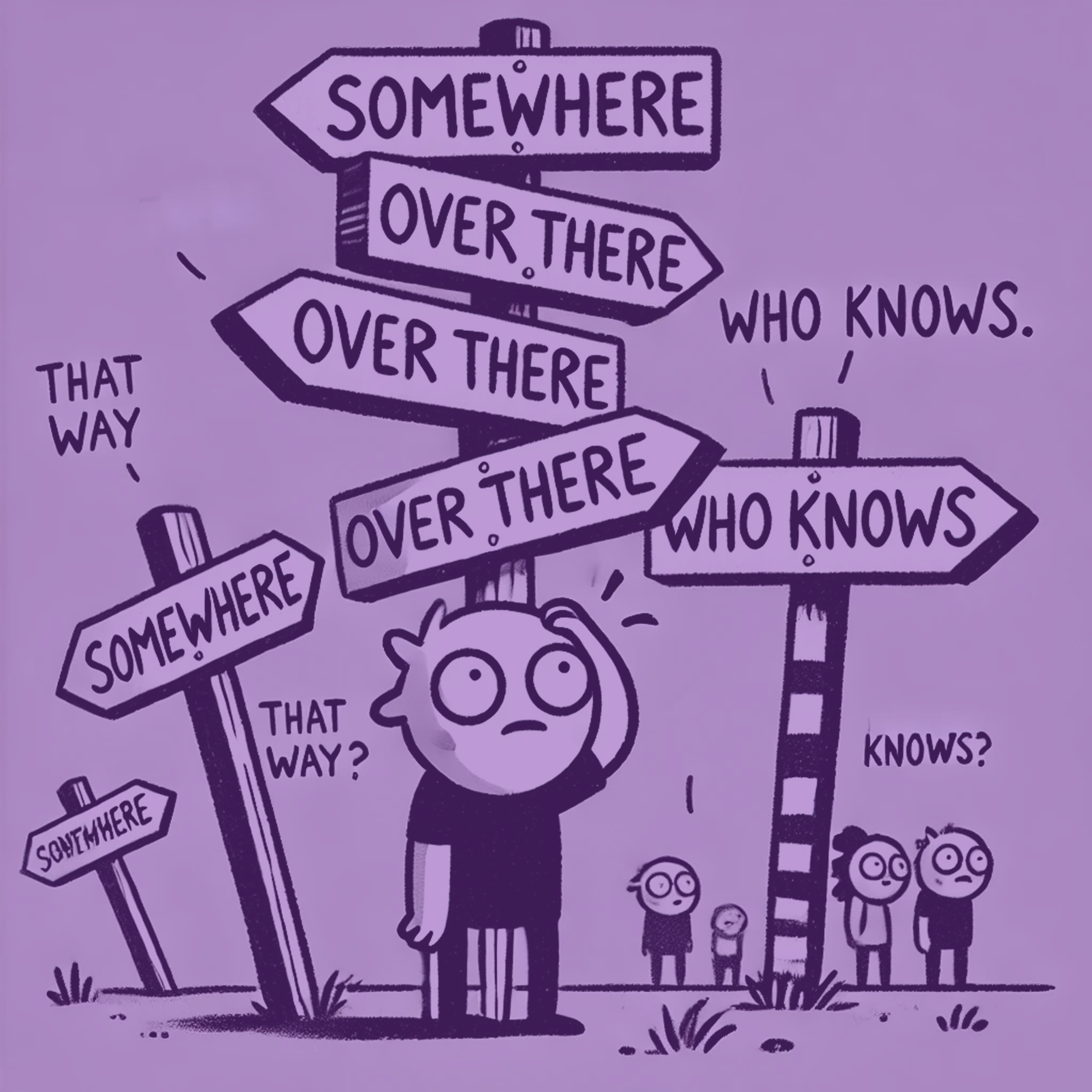
"If you don’t know where you are going, any road will get you there."
- Lewis Caroll
You are here…
When it comes to your organisation, your product, and AI…do you really know where you are? This is a genuine question, and many people’s natural answer is: of course, we do!
This is your reality check. To be completely honest, with technological advancements knocking on our doors every two days, it is very easy to get lost!
The path to AI adoption doesn’t start with technology—it begins with understanding the perspective of your key stakeholders, your organisation’s readiness, and your users' needs.
Let’s examine how you can best evaluate, understand and approach your starting point.
Don’t want to miss the upcoming articles in this series on setting AI product feature goals, metrics, planning, and more?
Starting point
You might have decided to pursue AI as a solution through different routes. Each one of these starting points will highly influence what the next step you take looks like. There is a tendency to think that if you didn’t get here through a specific user problem, you are doing it wrong. Organisational reality is that none of these starting points is wrong or right. There is no one-size-fits-all deterministic standard starting point when it comes to AI, a product or an organization, for that matter. It is also not very useful to throw our hands up in the air and refuse to interact with anything other than a specific user problem. The ultimate goal is to set out on a journey, the destination of which absolutely should be a solution to a user problem that drives better customer satisfaction, more revenue, etc. So, let’s look at some of the most common starting points and their potential approaches - to get us from here to there.
An internal drive for innovation
“We need to innovate with an AI initiative”
This is a common starting point, which I also covered in a previous article. In this instance, you are looking for one or more problems for which an AI-driven product feature might be a good solution.
Approaches to consider for this starting point:
Greater time and resource investment in AI product discovery: what opportunities would an AI-driven product feature be a more efficient, more innovative or quicker [insert your metrics here] solution for?
Series of smaller open experiments exploring the art of the possible
The nature of this type of AI initiative needs to be framed as being focused on experimentation and innovation. It is essential to set expectations with your product squads that the goal for these initiatives is to explore, to try out new things, to go beyond the boundaries of what is commonly done - all while reassuring them that it is okay if 90% of this work will likely never see it to production. And you know what, that is fine. Forcing some of these experiments into production can ultimately be counterproductive as without user validation, it is a shot in the dark. Fancy AI features, for all their glitter and glow, do nothing for your users unless they solve an actual problem. Exploring the art of the possible is about learning, educating the broader organisation, foraying into the unknown and just maybe, finding a hidden treasure.
Or, as the Grimm tale goes: “You need to kiss many frogs before you find your prince.”
Tactics your product team can use for this approach include:
Organising an innovation day, including members of the leadership team
Create space with dedicated AI Discovery sprints
Design thinking and innovation methods, like the AI Design Sprint
Quick prototyping (using AI Tooling 😉)
Deploying an open-ended Conversational AI Agent to gather the type of questions users are currently not getting answers to via your existing materials or product - for example, OpenDialog’s Digital Concierge
Market pressure
“Our competitors are using AI successfully - when can we get something live?”
Another common starting point for considering AI-driven products is the competitive landscape. As competitors implement and heavily communicate their latest AI-powered features in their products, organisations may feel pressure to implement AI-driven product features. Similarly, competitors might already be gaining efficiency, speed, and user growth thanks to AI features they have prioritised.
Approaches to consider for this starting point:
Focus on strategic benchmarking and competitive intelligence: how can AI be leveraged in your product to offer a unique experience compared to competitors’?
Lean AI feature experiments with a fast and tight user feedback loop
Prioritization of AI-driven features with a high-impact, low-complexity setup
When undertaking this type of AI initiative, it is easy to fall into the trap of checking the same boxes as your competitors. Although feature parity keeps you on the market, it does not help you stand out amongst the crowd. The nuggets you are looking for are AI features that provide real user value and add to your differentiation in the market.
Tactics your product team can use for this approach include:
Comprehensive competitor analysis focussed on success metrics around AI features
Ideation using the SCAMPER method
Exploratory user interviews and user journey mapping
A/B testing AI-enhanced features with traditional features & analysing user data
These tactics can be enhanced by using a Large Language Model as an ideation companion.
Prompt example
Role: you are a product manager
Product: ACME is a parental control application allowing parents to adjust parameters for their children's devices. The application allows parents to restrict content, approve or disapprove apps, set screen times, and more.

Given a specific <starting point> you are tasked to determine a list of features to prioritise, using <method> in order to accomplish the <goal>

<starting point>
Market Pressure
<starting point>

<goal>
Identify innovative features in the market not yet released by competitors
<goal>

<method>
- Competitive analysis of AI features released by competitors
- SCAMPER method
<method>
Customer expectations
“Our customers asked us for [USER REQUEST] - can AI help us accomplish that?”
This starting point starts with a well-defined problem that has surfaced, either from direct customer feedback or through internal business needs, and can represent an excellent opportunity to drive AI-driven product development within the organisation. It is more likely to yield short-term results based on an actual problem it solves. As always, there is a catch: Is an AI-driven product feature the best solution to this specific problem?
Approaches to consider for this starting point:
Assess the problem - AI solution fit. Is AI truly needed, or can the problem be solved differently, more efficiently or simpler?
Assess user‘s readiness to use AI as a solution to this specific problem
Definition of clear success metrics tied to business KPIs
Low-risk proof of concept build to test the idea before fully investing in an AI-driven solution
The risk with this type of initiative is diving head-first into a solution, as you might have the impression that the problem has already surfaced. It is important to note that although the starting point here is a specific customer request, these do not always expose the root cause of what users are trying to accomplish. Therefore, giving the product team enough space to conduct research and discovery will be essential before pressing for a specific AI-driven solution.
Tactics your product team can use for this approach include:
Root cause analysis
Usability testing on existing product features in relation to the user request
User surveys
Prototype testing with users
Prompt example
Role: you are a product manager
Product: ACME is a parental control application allowing parents to adjust parameters for their children's devices. The application allows parents to restrict content, approve or disapprove apps, set screen times, and more.

Given a specific <starting point> you are tasked to determine a list of features to prioritise, using <method> in order to accomplish the <goal>

<starting point>
User Request: avoid my child to trick the app into surpassing the screentime limit
<starting point>

<goal>
Identify an AI-driven product feature that can help the user accomplish the goal expressed in their request
<goal>

<method>
Root cause analysis
<method>
An identified use case
“AI capabilities would be a great solution for this opportunity”
You have now officially exited the wild west of potential use cases and pinpointed a use case for which an AI-driven product feature would be an excellent fit. Isn’t this a nice, clear starting point?! Many questions remain unanswered, but there is a clear focus, and you can start concentrating on moving your use case forward.
Conclusion
You might find yourself at the start of an AI initiative for your product in many ways.
Each of these starting points has its risks and pitfalls but also benefits.
The question to ask oneself is not how frustrated one should be about this not being a clearly defined use case but rather, given this specific starting point, what is the best approach?
Join the AI Product Focus tribe
You can expect AI Product Focus to appear regularly with articles including opinion pieces, a practical AI Product Building series, research, frameworks and more.
👀 Sneak Peek into Part 2: Points of Orientation
As a product leader, you are part of a wider ecosystem that comprises your product, certainly, but equally your executive leadership, the wider organisation, and last but not least, your existing and potential customer base.
These are your points of orientation, when it comes to determining where you are in your quest to enhance your product with AI. They are foundational orientation points when thinking about the strategy and narrative you will need to adopt to drive an AI-driven initiative.